

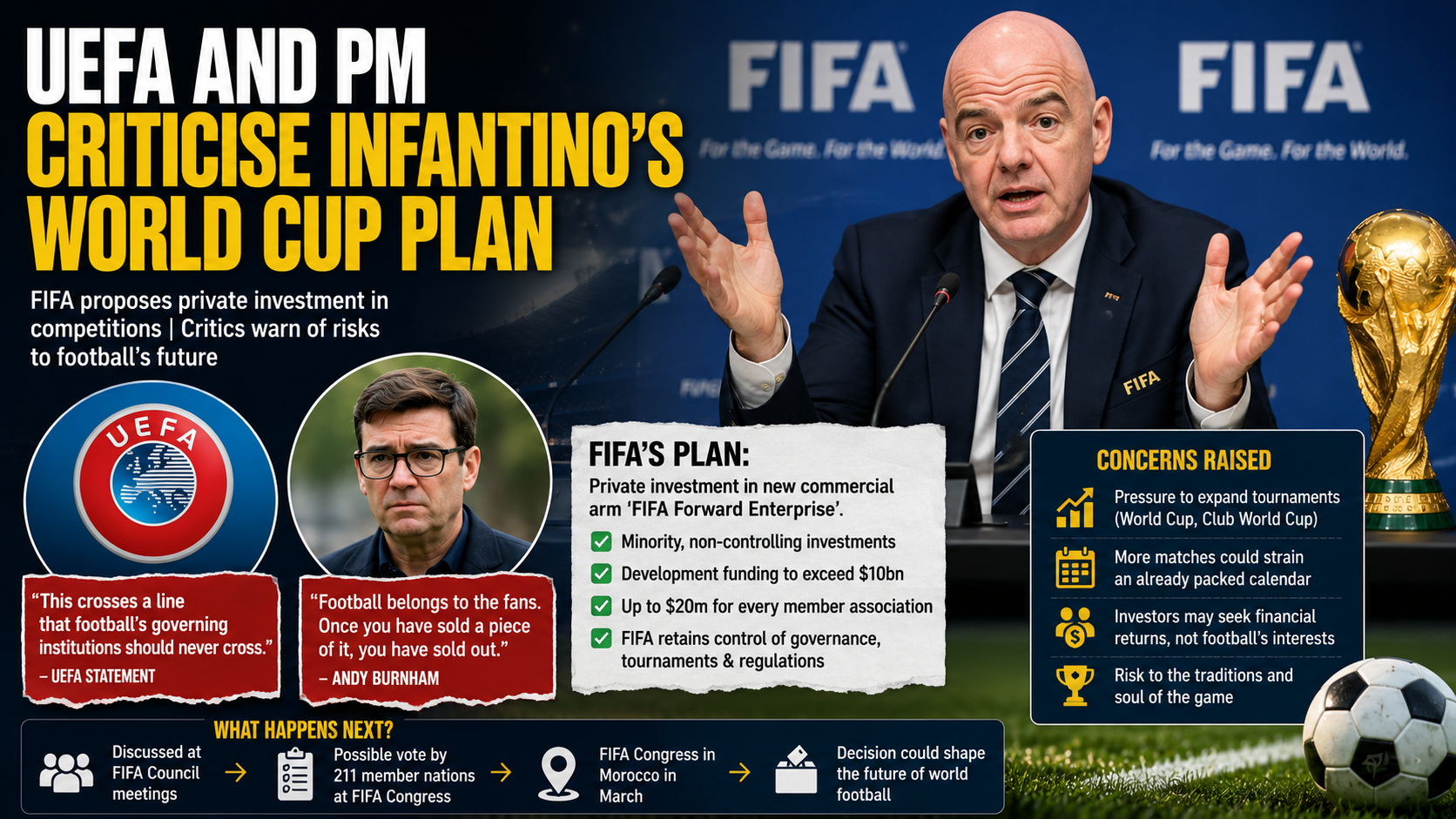
UEFA and Political Leaders Raise Concerns Over FIFA Investment Proposal
FIFA’s proposal to attract private investment into its commercial operations, including competitions such as the FIFA World Cup, has sparked strong criticism from UEFA and political figures.
The global governing body has announced plans to increase worldwide football development funding to more than $10 billion (£7.5 billion) through the creation of a new commercial subsidiary. The initiative would allow outside investors to purchase minority, non-controlling stakes while FIFA retains overall authority.
Fans looking to stay informed about major football developments, governance updates and international football news can also follow the latest coverage at Football Today.
FIFA Unveils New Commercial Strategy
Under the proposal, FIFA intends to establish a new entity called FIFA Forward Enterprise (FFE), bringing together its commercial rights and event-related business operations.
If approved by FIFA’s 211 member associations, selected investors would be invited to acquire minority interests in the new organisation. FIFA has indicated that Thrive Eternal, an investment group led by American venture capital firm Thrive Capital, is expected to head the proposed investment consortium.
The governing body has stressed that it would continue to maintain complete control over football governance, tournament organisation, regulations and the international match calendar.
FIFA President Gianni Infantino said the objective is to ensure football’s commercial success benefits every nation rather than only the sport’s wealthiest organisations.
He explained that while football has generated enormous financial value in certain parts of the world, FIFA’s responsibility is to support sustainable growth and investment across every member association.
UEFA Voices Strong Opposition
UEFA has reacted sharply to the proposal, arguing that football’s governing institutions should not commercialise ownership of the sport in this way.
European football’s governing body warned that introducing private investment into FIFA’s competitions risks creating long-term financial pressures that could encourage further expansion of tournaments to satisfy investors.
According to UEFA, football’s governance and heritage should never become commercial assets, particularly without complete transparency regarding who may benefit financially.
The organisation believes the proposal represents a significant shift in how football’s biggest competitions could be managed in the future.
Political Criticism Adds to Debate
The proposal has also attracted criticism from political leaders.
Andy Burnham argued that football belongs to supporters rather than investors and warned against allowing financial interests to influence the game’s most prestigious competitions.
He described the FIFA World Cup as one of world sport’s greatest tournaments, insisting that its value lies with the fans, players and communities who have supported football for generations.
Meanwhile, the Football Association confirmed it had not been informed about the proposal before FIFA publicly announced its plans.
FIFA Defends the Proposal
FIFA insists the new commercial structure follows models already used successfully in other sports.
The governing body emphasised that selling minority investment stakes would not affect its decision-making powers, as FIFA would continue overseeing all sporting regulations, international competitions and scheduling.
The organisation believes the additional investment would allow every member association to receive as much as $20 million (£15 million) in one-off funding to improve football infrastructure and development projects.
Experts Warn of Possible Tournament Expansion
Football finance specialists have suggested the proposal could significantly increase FIFA’s commercial income while also creating new expectations from investors seeking financial returns.
Some observers believe this could eventually result in larger World Cups, more frequent international tournaments or further expansion of the Club World Cup.
Such changes would inevitably place additional strain on an already crowded football calendar, affecting domestic leagues, continental competitions and player workloads.
While the financial support would be transformative for many developing football nations, critics argue that commercial pressures could reshape the future of international football.
Key Decisions Still to Come
The proposal is expected to be discussed at upcoming FIFA Council meetings before potentially being presented to all member associations for a formal vote at the FIFA Congress in Morocco next year.
If approved, the initiative would represent one of the biggest structural changes in FIFA’s commercial history and could influence the future direction of football for decades.
Why the Proposal Matters
Many within football view the plan as one of the most significant governance issues since the European Super League debate.
Supporters of the proposal believe additional investment could accelerate football development worldwide, particularly in emerging nations that need greater financial support.
Opponents, however, fear commercial interests could eventually influence decisions regarding tournament formats, scheduling and expansion.
As discussions continue, the balance between growing football’s revenues and protecting the traditions of the game is likely to remain one of the sport’s biggest talking points.