

English Football Introduces New Trial to Discourage Goalkeeper Time-Wasting
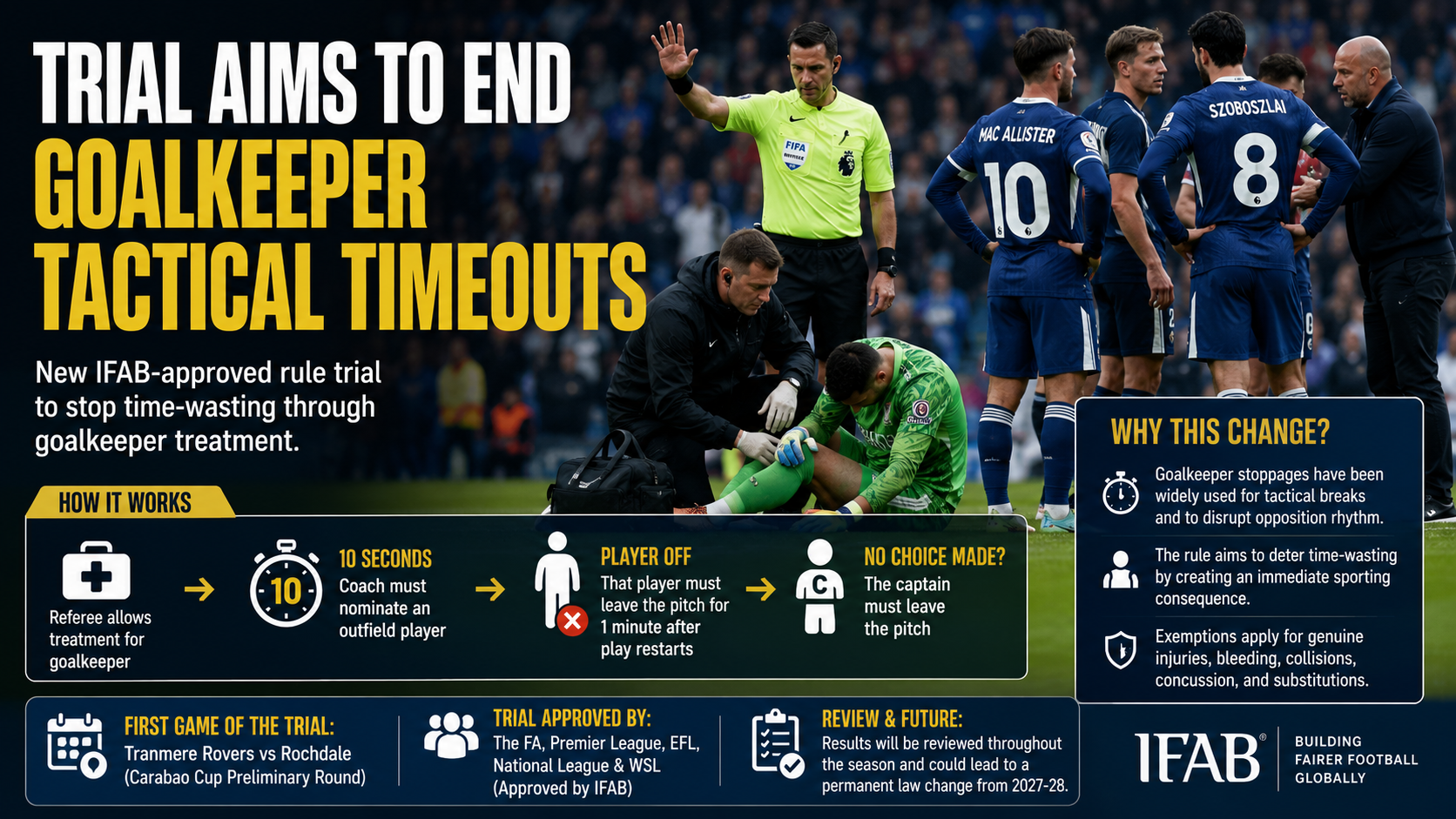
English football is set to test a new rule designed to stop teams from using goalkeeper injuries as tactical breaks during matches.
The initiative has been approved by the Football Association (FA), Premier League, English Football League (EFL), National League, and Women’s Super League (WSL) after receiving permission from the International Football Association Board (IFAB). The trial aims to reduce deliberate stoppages that allow teams to regroup or disrupt an opponent’s momentum.
Supporters looking for the latest football news, rule changes, and match analysis can also stay informed by visiting Football Today.
How the New Rule Will Work
Under the trial, if a referee stops play so that a goalkeeper can receive treatment from the medical staff, the goalkeeper’s team will face a temporary consequence.
The team’s coach will have just 10 seconds to nominate an outfield player who must leave the pitch for one minute once play resumes. The chosen player must be communicated to the fourth official within the time limit.
If no decision is made before the deadline, the team captain will automatically be required to leave the field instead.
The first fixture to use the new procedure will be the Carabao Cup preliminary-round match between Tranmere Rovers and Rochdale.
Meanwhile, Australia’s A-League is expected to test a similar version of the rule, although in that competition the captain will always be the player required to leave the pitch.
Why Football Authorities Are Taking Action
In recent seasons, goalkeeper stoppages have increasingly been viewed as a tactical tool rather than genuine medical incidents.
Teams have frequently used these breaks to gather around the technical area while coaches deliver instructions. In other situations, goalkeepers have gone to ground to interrupt the opposition’s rhythm during periods of sustained pressure.
One notable example came in November when Leeds United manager Daniel Farke accused Manchester City goalkeeper Gianluigi Donnarumma of exaggerating an injury to slow the game and halt Leeds’ momentum.
Football authorities believe the new trial will discourage clubs from exploiting this loophole.
IFAB Also Clarifies VAR Procedure
Alongside the new trial, IFAB has issued further guidance regarding the use of VAR in mistaken identity situations.
The clarification follows incidents at the 2026 FIFA World Cup, where Miguel Almirón of Paraguay and Breel Embolo of Switzerland received yellow cards for simulation after video review. Embolo’s booking resulted in his dismissal because he had already been cautioned earlier in the match.
Although IFAB considers the approach promising, it confirmed that the procedure cannot be adopted permanently until its wider review of VAR protocols has been completed.
Designed to Prevent Tactical Abuse
Earlier this year, IFAB chairman of referees Pierluigi Collina highlighted goalkeeper tactical stoppages as an issue requiring urgent attention.
Officials at the 2026 World Cup were instructed to stop players gathering around coaches during injury breaks. However, football authorities in England concluded that this measure alone would not eliminate the problem.
Instead, requiring a team to play temporarily with only ten outfield players creates a direct sporting disadvantage, making unnecessary goalkeeper stoppages far less attractive.
The principle mirrors the existing rule applied to injured outfield players, who must also leave the field briefly after receiving on-pitch treatment.
Former Players Welcome the Proposal
Former Liverpool midfielder and Match of the Day pundit Danny Murphy previously suggested introducing a similar rule change.
Murphy argued that if goalkeepers receive treatment, another player should temporarily leave the field instead, creating a fair balance for both teams while discouraging tactical delays.
The new trial closely reflects that proposal and is intended to act as a preventative measure rather than punishing teams after they have already gained an advantage.
Situations Where the Rule Will Not Apply
There are several important exceptions where no outfield player will need to leave the pitch:
- The goalkeeper does not require medical treatment and play has not been stopped.
- The goalkeeper collides with a teammate.
- The goalkeeper is fouled and needs immediate treatment.
- The goalkeeper is bleeding.
- A serious injury or concussion requires immediate medical attention or substitution.
- The goalkeeper is replaced during the stoppage.
These exemptions are designed to ensure genuinely injured players continue to receive appropriate medical care without penalty.
Trial to Be Closely Monitored
Some observers have raised concerns that the temporary numerical disadvantage could encourage injured players to remain on the pitch instead of requesting treatment.
Football’s lawmakers will monitor the trial throughout the season before assessing its effectiveness. If the results prove successful, IFAB could introduce the rule permanently across world football from the 2027-28 season.
Final Thoughts
The new goalkeeper treatment trial represents one of the most significant attempts in recent years to reduce tactical time-wasting in football. By introducing an immediate sporting consequence for unnecessary stoppages, officials hope to keep matches flowing while preserving fairness for both teams.
If successful, the experiment could pave the way for a permanent global law change, helping eliminate one of the game’s most debated tactical loopholes.