

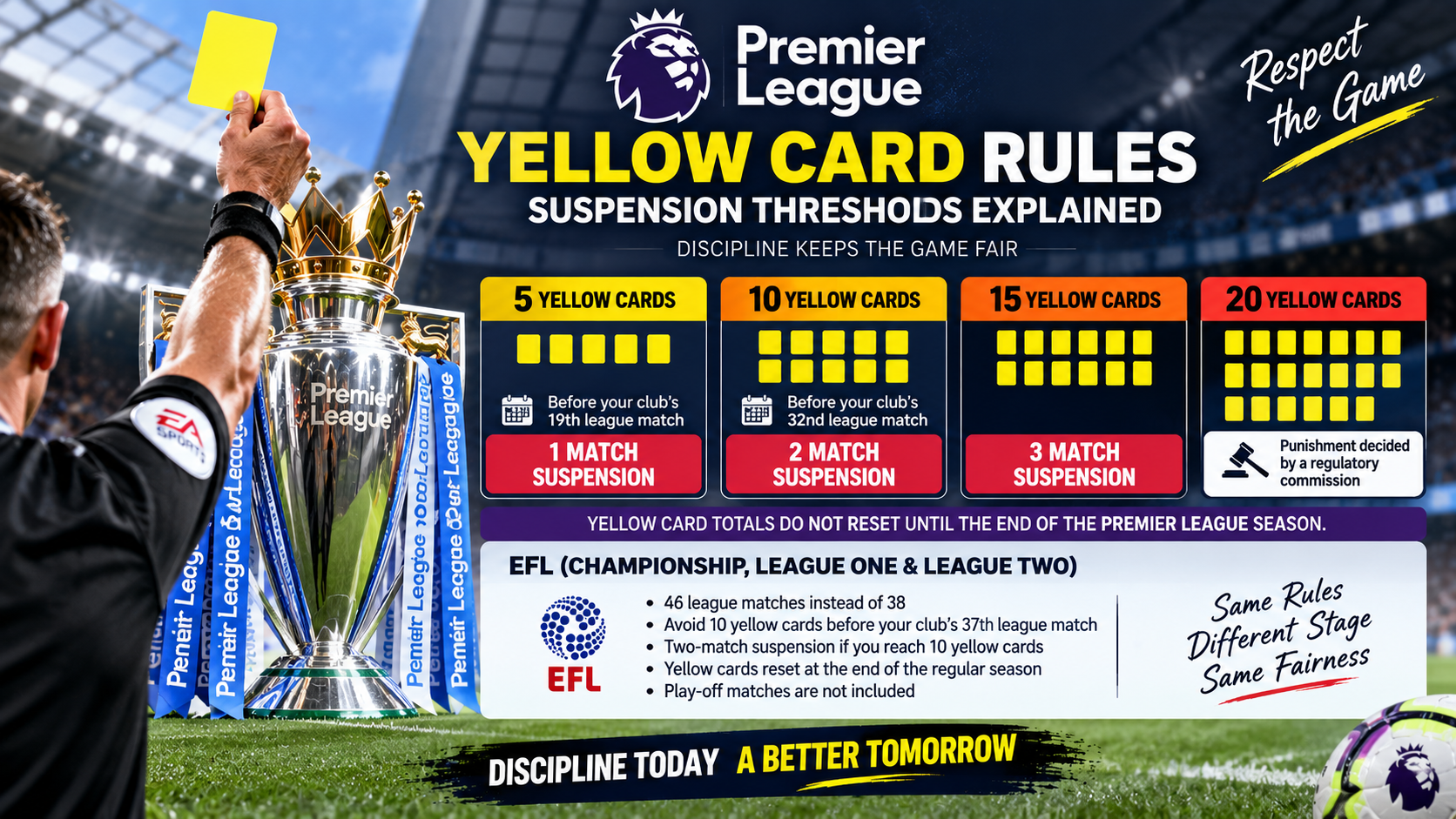
Premier League players can receive a one-match suspension if they collect five or more yellow cards before the end of their club’s 19th league match of the season.
After the opening four rounds of fixtures this campaign, three players have already been booked three times. As a result, they must avoid receiving two additional cautions before their teams reach the halfway point of the season.
Once that stage has passed, the disciplinary threshold changes. Players who collect 10 yellow cards before the conclusion of their club’s 32nd league match will be handed a two-match suspension.
Further suspension limits apply at 15 and 20 yellow cards.
A player who reaches 15 bookings receives a three-match ban. However, any punishment for accumulating 20 yellow cards is decided by a regulatory commission.
These yellow-card totals remain active throughout the Premier League season and do not reset until the campaign has ended.
For regular football results, fixtures and the latest match updates, readers can also visit Football Today.
Yellow Card Rules in the EFL
Similar disciplinary rules are used in the Championship, League One and League Two.
However, each of those divisions plays 46 league matches rather than 38. Therefore, players must avoid reaching 10 yellow cards before the end of their club’s 37th league match to prevent receiving a two-match suspension.
In the EFL, yellow-card totals are reset once the regular league season finishes. Bookings from play-off matches are not included in the calculation.
Which Premier League Players Have the Most Yellow Cards?
Following the first four rounds of Premier League fixtures, the players listed with three yellow cards are:
- Dominic Calvert-Lewin – Leeds United: Three yellow cards
- Adam Smith – Bournemouth: Three yellow cards
- Vitaly Janelt – Brentford: Listed among the players with the most yellow cards
Players approaching the relevant suspension thresholds will need to manage their discipline carefully, particularly as another booking could lead to a significant absence later in the campaign.