

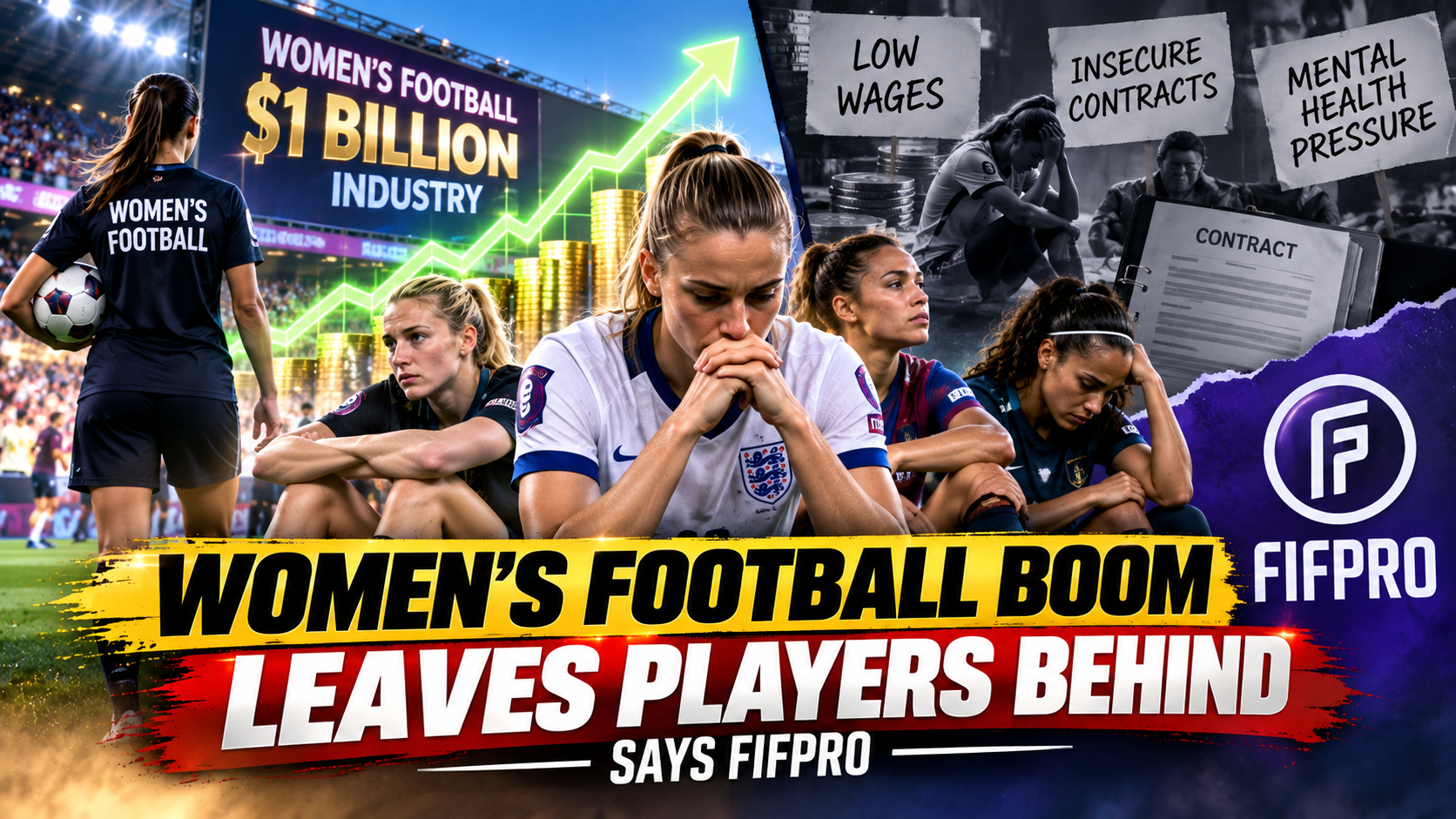
Women’s football is rapidly developing into a billion-dollar industry, but a growing number of professional players continue to face low salaries, uncertain contracts and increasing mental health pressures, according to a new report from global players’ union FIFPRO.
The findings are based on a survey of more than 800 female footballers worldwide. The research raises concerns about whether the sport’s commercial success is translating into better working conditions and stronger protection for the players responsible for its growth.
Among players who were considering ending their careers earlier than planned, 59% identified financial difficulties as a factor, while 46% pointed to psychological stress.
Alex Culvin, FIFPRO’s head of women’s football, said the reasons behind these concerns were complex. Greater public attention, financial uncertainty and insufficient support systems were among the factors contributing to the problem.
“Players are now very visible,” Culvin said.
She explained that players were increasingly expected to maintain a public profile, with some relying on additional income opportunities to compensate for inadequate or inconsistent earnings from football.
Although conversations about mental health have become more common, many players still feel they lack adequate assistance.
Culvin said footballers had reported experiencing significant psychological pressure without receiving the support they needed from their clubs or national teams.
The survey found that 57% of respondents had struggled with their mental health. Half of those affected said their clubs had not provided support.
Women’s Football Revenue Is Growing, but Player Welfare Remains a Concern
The report forecasts that worldwide revenue from women’s football will increase from approximately $581 million (£439 million) in 2024 to more than $1 billion (£756 million) by 2027.
However, FIFPRO warns that financial growth and increased visibility have not eliminated the insecure conditions experienced by many players.
Social media has also changed the relationship between footballers and supporters. While digital platforms allow players to connect with fans more easily, greater accessibility can expose them to online abuse and harassment.
Since 2017, salaries, investment and public exposure have increased significantly across women’s football. Nevertheless, many parts of the professional game continue to operate without the financial security and employment protections players need.
Culvin believes the commercial argument for investing in women’s football has already been established. The next priority, she argues, should be stronger regulations and policies that protect players and help them perform at their best.
For more football news, industry developments and coverage of the women’s game, visit Football Today.
Many Top-Tier Players Do Not Feel Fully Professional
One of the report’s most notable findings concerns how female footballers view their own professional status.
Under FIFA’s definition, a professional player must have a written contract and receive payment that exceeds the expenses associated with playing football.
Despite competing for clubs in their countries’ highest divisions, only 62% of survey respondents described themselves as professional. Another 27% identified as semi-professional, while 12% considered themselves amateur.
The figures also revealed gaps in basic employment arrangements. Just 78% of respondents said they had written contracts, and 82% reported receiving payments from their clubs.
More concerningly, only 57% said their earnings were sufficient to cover the costs of playing football.
Culvin argued that players who technically work as professionals but do not experience the security associated with professional employment are missing out on important employee benefits and protections.
Significant Differences in Women’s Football Salaries
Average monthly earnings have increased substantially since 2017. The reported mean salary has tripled to $2,601 (£1,970), but the median monthly figure remains considerably lower at $1,669 (£1,250).
Pay also varies sharply between regions.
North America recorded average monthly earnings of $6,450 (£4,886), followed by central and Western Europe at $3,982 (£3,016). The corresponding figures were $878 (£664) in Eastern Europe and just $480 (£363) in Africa.
Although salaries have risen considerably in some markets, including the United States and Mexico, the report found that average earnings in 10 Eastern European countries remained below their respective national minimum wages.
In Western Europe and Asia/Oceania, average salaries were also not substantially higher than minimum-wage levels in some countries.
FIFPRO did not provide individual league salary averages because its research examined regional trends rather than reporting figures for each country or competition.
Short Contracts and Delayed Wages Leave Players Vulnerable
Contract security remains another major challenge for women in professional football.
The average contract length has increased from approximately 12 months in 2017 to 19 months. However, many players still face employment arrangements that leave them without a guaranteed income throughout the year.
Culvin noted that only around two-thirds of players receive wages for all 12 months. Others sign contracts lasting seven or nine months, forcing them to find alternative work or income for the remainder of the year.
The rapid expansion of women’s football, particularly in prominent competitions such as England’s Women’s Super League, can make these problems less visible.
While leading clubs and players benefit from increasing commercial investment, the experience of footballers elsewhere in the sport can be very different.
The report found that 24% of respondents had experienced late payments during the previous two seasons. In addition, 42% said they were not provided with a pension.
These findings highlight the gap between the growing value of women’s football and the financial security available to many of its players.
FIFPRO Calls for Stronger Protection and Accountability
Culvin believes football’s governing bodies and clubs need to recognise that many players continue to face serious difficulties despite the sport’s rapid progress.
She called for stronger accountability and more comprehensive support systems, arguing that players’ needs must be taken into account when decisions affecting their careers are made.
However, the report also identified an encouraging improvement concerning parenthood.
In 2017, almost half of the players considering an early retirement said that starting a family could influence their decision to leave football.
That proportion has since fallen to 19%. FIFPRO links the improvement partly to FIFA’s maternity regulations, introduced in 2021 and subsequently updated.
Culvin described the change as evidence that targeted regulation can make a meaningful difference to players’ working lives.
The report nevertheless warns that the benefits of growth remain unevenly distributed. A relatively small proportion of elite players have gained from the biggest investments and commercial opportunities, while the majority continue to face insecure employment conditions.
Culvin said the industry remained heavily focused on its top 5% of players, leaving the other 95% more exposed to late wages, short contracts and periods without guaranteed income.
Commercial Growth and Player Protection Must Go Together
FIFPRO argues that women’s football should not have to choose between expanding its commercial reach and improving conditions for players.
Instead, the organisation wants investment, stronger employment standards and better welfare provisions to advance together.
The report’s central message is that the sport’s financial development must produce meaningful improvements across the entire professional game, rather than benefiting only its most prominent clubs and players.
Culvin also stressed that footballers should have a stronger voice in decisions affecting their careers and working conditions.
As women’s football moves towards the projected billion-dollar milestone, the challenge for governing bodies, leagues and clubs will be ensuring that players receive a fair share of the benefits and the support necessary to sustain their careers.